


Most discovery call debriefs go like this: the AE gives a verbal summary or fills in a few CRM fields, sends a follow-up email, and the deal moves to the next stage with half the MEDDIC blank.
The Problem
MEDDIC works as a framework. What breaks down is the debrief. Managers don’t have time to listen to every call. AEs self-report optimistically. And even when someone does listen, translating a 45-minute transcript into a crisp qualification gap analysis takes real cognitive work.
The result: deals enter the pipeline underqualified, forecasts are wrong, and reps spend cycles on accounts that aren’t closing.
What AI Makes Possible
Drop a call transcript into Claude with a structured MEDDIC debrief skill, and you get a scored qualification analysis, a sales leader commentary, a prioritized next steps list, and a ready-to-send mutual action plan email — in under two minutes.
This isn’t AI summarizing the call. It’s AI doing the analytical work a good sales manager would do: reading between the lines, flagging what wasn’t said, identifying the moment the seller should have pushed harder, and turning that into something the AE can act on immediately.
🛠️ New: Stage 2 GTM AI Skills on GitHub
We’ve launched a Stage 2 GitHub repo containing all of our GTM AI Skills — including the MEDDIC debrief skill referenced in this post — so you can fast-track these how-tos for your own team. Visit our GitHub to download the skill and plug it into your Claude workflow.
The How To
Step 1: Get your transcript
Most sales teams record calls via Gong, Chorus, Fathom, or Fireflies. Export the transcript as plain text — you don’t need the recording, just the words. If you’re working from notes, that works too, but the more specific the input, the more specific the analysis.
If you have Claude connected to your recorded calls automatically, you can just ask it to run the MEDDIC analysis against your calls during a specific time and it should pull them automatically.
What to watch out for: Transcripts with heavy small talk at the top (sports, tech issues, catching up) can dilute the signal. However, this skill will skip past preamble automatically and look for the moment the substantive conversation starts.
Step 2: Run the MEDDIC debrief skill
Paste the transcript into Claude and trigger the skill. The skill will:
Parse the transcript for deal context: stage, competitive situation, timeline, key stakeholders
Score each MEDDIC element (Strong / Partial / Missing) with specific evidence from the call
Render a visual scorecard so the gaps are obvious at a glance
Write a sales leader commentary identifying the critical misses and broader patterns
Generate 4–6 prioritized next steps ordered by urgency and deal impact
The prompt is simple:
Analyze this discovery call against MEDDIC and give me my next steps. [paste transcript]
Step 3: Review the scorecard and commentary
The scorecard is your quick read — any red (Missing) element is a live deal risk. But the real value is in the commentary. A good debrief will tell you:
The specific moment the seller should have pushed and didn’t
Whether your ‘champion’ is actually a champion or just a friendly coach
How the competitive situation actually looks vs. how the AE described it
The pattern in how this AE runs calls — not just this deal
Real example: On a recent portfolio company call, the AI flagged that the rep let the buyer name the actual decision-maker and then never asked how to get to him. The call ended with ‘let’s reconnect in May’ — which isn’t a next step, it’s a prayer. That’s the kind of miss that’s obvious in hindsight but easy to miss in the moment.
Step 4: Send the mutual action plan email
The skill generates a ready-to-send MAP email for the AE to send to their buyer contact within 24 hours. The email:
Opens with something specific the buyer said — not generic ‘great talking to you’
Summarizes what was covered from the buyer’s perspective, not the seller’s
Lists what the seller is sending first, before making any asks
Includes a clean action table with owner and target date for each next step
Closes with a frictionless CTA — easy for the buyer to confirm
This isn’t just a nice-to-have. A MAP email forces the AE to commit to specific deliverables, gives the buyer something to react to (which flushes out ghosting early), and creates a written record of what was agreed. Deals with documented next steps close faster.
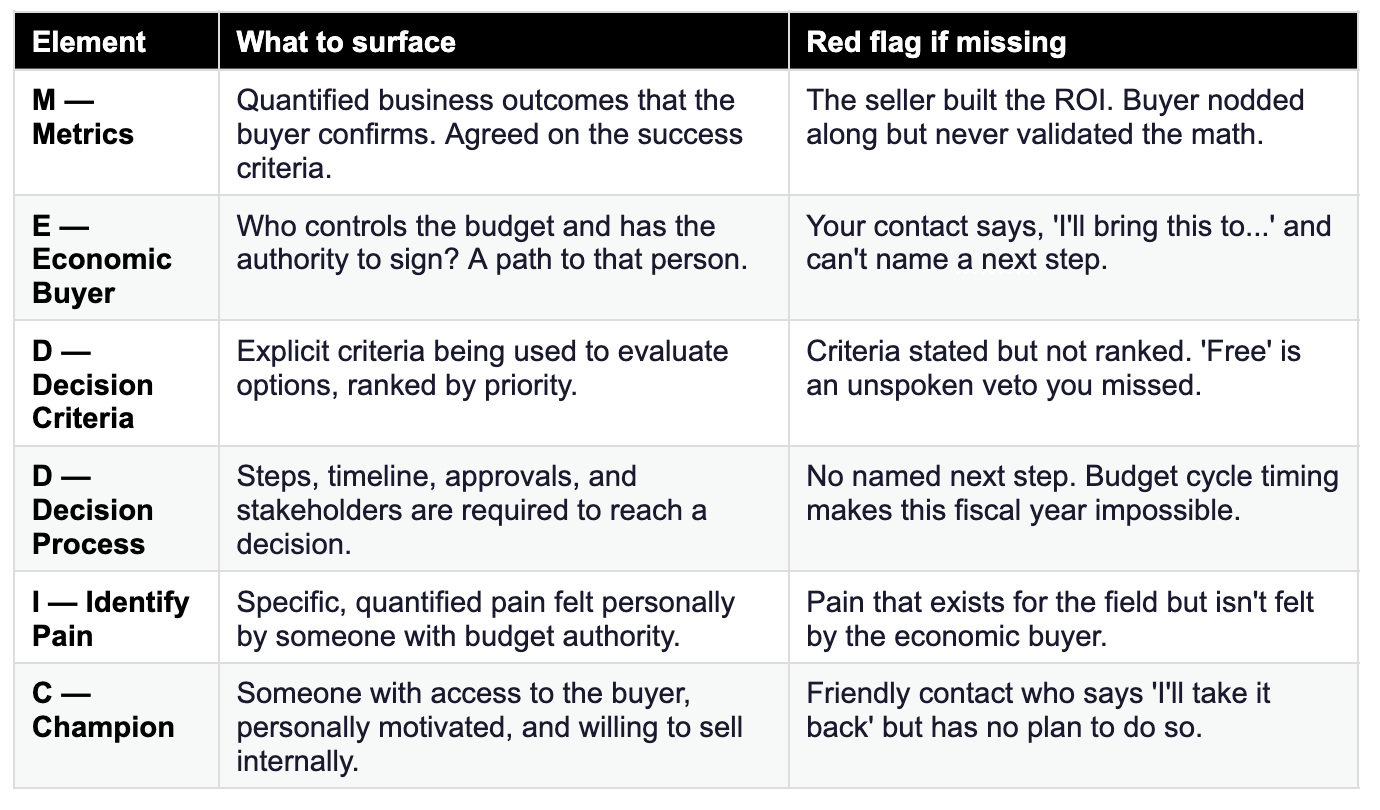
Quick Reference: What to Surface in Each Element
What Good Looks Like
A strong AI-assisted MEDDIC debrief will be uncomfortable to read. It should name things the AE didn’t want to flag — the champion who hasn’t committed to anything, the budget cycle that probably rules out this fiscal year, the ‘free competitor’ objection that was addressed technically but never economically neutralized.
It’s a great opportunity for the AE to continue to learn the art of discovery without impacting their current pipeline.
Watch-Outs
Garbage in, garbage out: If the AE’s notes are thin or the transcript is heavily garbled, the analysis will be thin too. This skill rewards teams who record and transcribe calls.
Don’t skip the review: AI will flag gaps based on what was said. It can’t know what the AE knows from offline conversations. Always sanity-check the debrief against the full relationship context.
The MAP email needs a human read before sending: The skill will draft commitments based on what was discussed on the call. Make sure the AE isn’t promising something they didn’t actually agree to send.
The Takeaway
MEDDIC doesn’t fail because reps don’t know the framework. It fails because the debrief process doesn’t give it teeth — there’s no one with the time and the transcript access to do the analysis consistently, at scale, after every call.
AI closes that gap. Not by replacing sales judgment, but by doing the analytical legwork so the manager can spend their time on coaching, not call review. The sellers who adopt this workflow will have better-qualified pipelines, fewer stalled deals, and follow-up emails that actually get responses.
Great insights.