


DEAR STAGE 2: Our deals keep stalling at the CFO. I know “build a better business case” is the answer, but every template I’ve seen feels like the same fake 10x assumption dressed up. What does a business case that actually survives CFO scrutiny look like? -- SELLING TO FINANCE
DEAR SELLING TO FINANCE: You’re in lock step with your champion. Your pricing is fair. And you’re still losing at the finish line. Turns out we are all selling to finance now and what’s happening at the CFO stage is usually more about proof than pricing. The CFO is (rightfully) skeptical of your math (think of the time savings and revenue if all of our ROI calculator promises actually came to be!!). So when the math can’t be verified, the deal collapses into a negotiation about discounts instead of a conversation about the value.
This week I chatted with Kenny Scannell, Stage 2 LP and CRO at Otter.ai who has spent 20+ years scaling revenue teams at companies like Rocketlane, Zoom, and Klaviyo and he shared a real life example of building out a business case and evolving it from a google sheet into a live product using Lovable.
The mistake most sales teams make is treating discovery and business-case creation as separate activities. The strongest business cases are built during discovery itself. Every question becomes an input. Every workflow becomes evidence. By the time you present to the CFO, you are not introducing a new narrative. You are organizing information the prospect already helped create.
Build the Case From the Prospect’s Own Data
Most business cases are built on case studies. “Company X got 10x ROI. You will too.” As Kenny puts it: ‘Every time you get to a CFO, they call BS.’ The issue is not that CFOs dislike ROI. It is that generic vendor assumptions rarely hold up. Once the CFO decides the numbers are not grounded in their business, the conversation shifts from value to price, and the seller loses credibility.
At Rocketlane, Kenny’s team identified roughly 35 common activities performed by implementation teams inside their existing PSA or project management platform. For each activity, they captured the current time required, then compared it to the same workflow inside Rocketlane.”
The data didn’t come from case studies. It came from the prospect. As Kenny describes it: “We’d actually go through an interview process with an IC and a manager.” Running these interviews in parallel to the deal is the key move. Discovery isn’t just generating rapport or qualifying the deal. It’s generating the inputs for the business case at the same time. By the time you get to the CFO, you’re not presenting your assumptions. You’re presenting their data back to them.
The math becomes verifiable. “It’s as simple as saying, hey, to migrate this template and do this and that, it takes you five minutes today on this system. And then we start to compare and contrast. Within Rocketlane, it takes you one minute because we have AI. The inputs from Rocketlane on how long these tasks take are all provable through demos.”
A CFO can push back on a benchmark from a vendor’s case study. It’s a lot harder to push back on a time estimate from your own IC.
What It Looks Like When It Works
Kenny’s team started with a Google Sheet. Eventually they built a business case creator in Lovable so prospects could fill it out themselves and get a real-time ROI score. The Lovable version made the case more interactive. Instead of a rep manually maintaining a spreadsheet, prospects could enter their own operating assumptions, see the calculations transparently, and adjust variables in real time. The result: win rate went from 18% to 34% over four quarters.
Now at Otter.ai, they’ve taken it a step further: discovery transcripts become the raw material for the business case. The team connects Otter’s MCP server to Claude, pulls the relevant discovery call context, combines it with a Google Drive business-case template, and generates a first draft in about two minutes. Rather than starting from a blank page, reps start with a case populated from the prospect’s own words.
In fact they’ve now created 2 swim lanes - one Lovable product that can be used with the prospect to gather the interview feedback noted above and one to create the finished product.
The rep starts here:
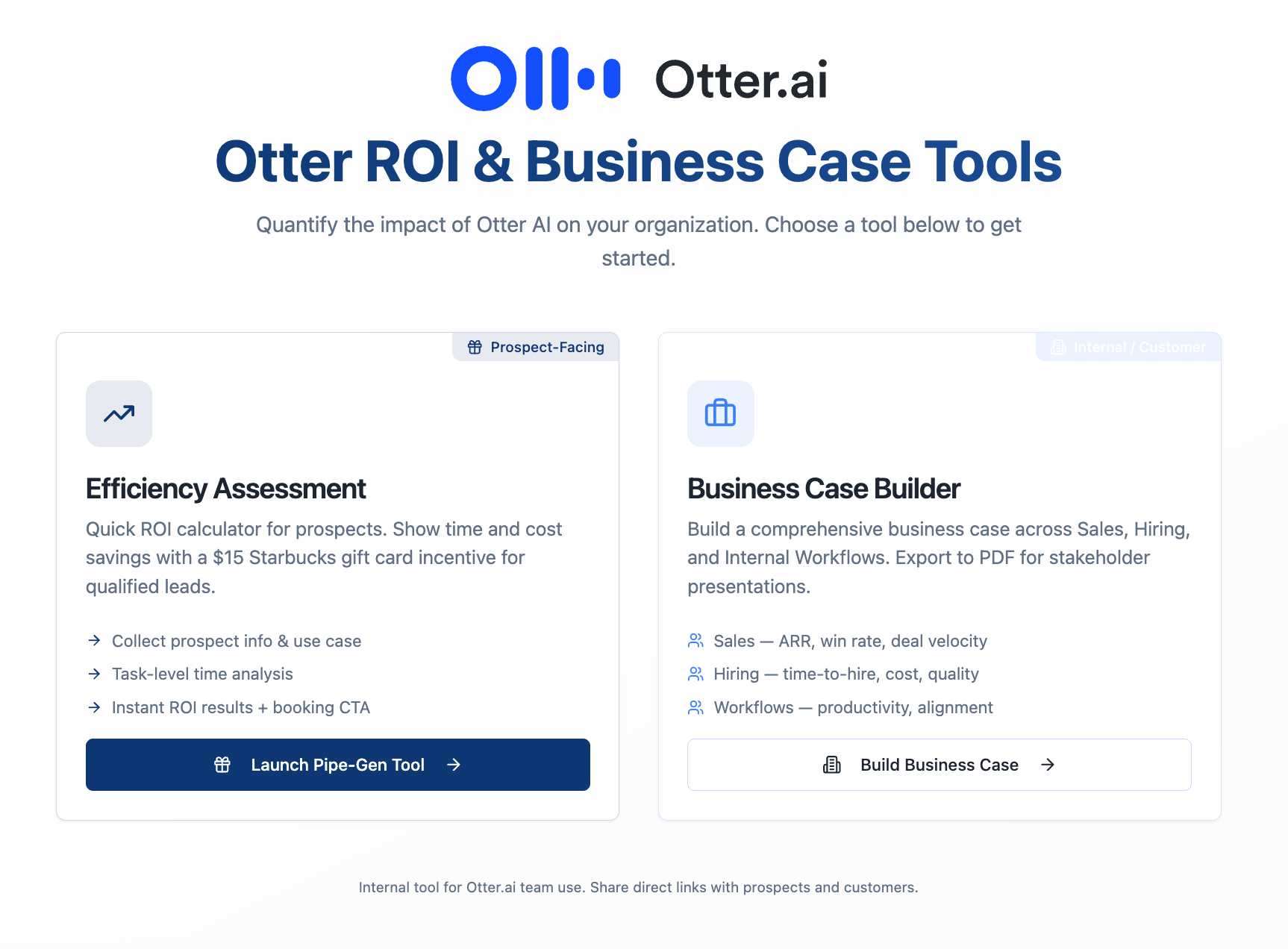
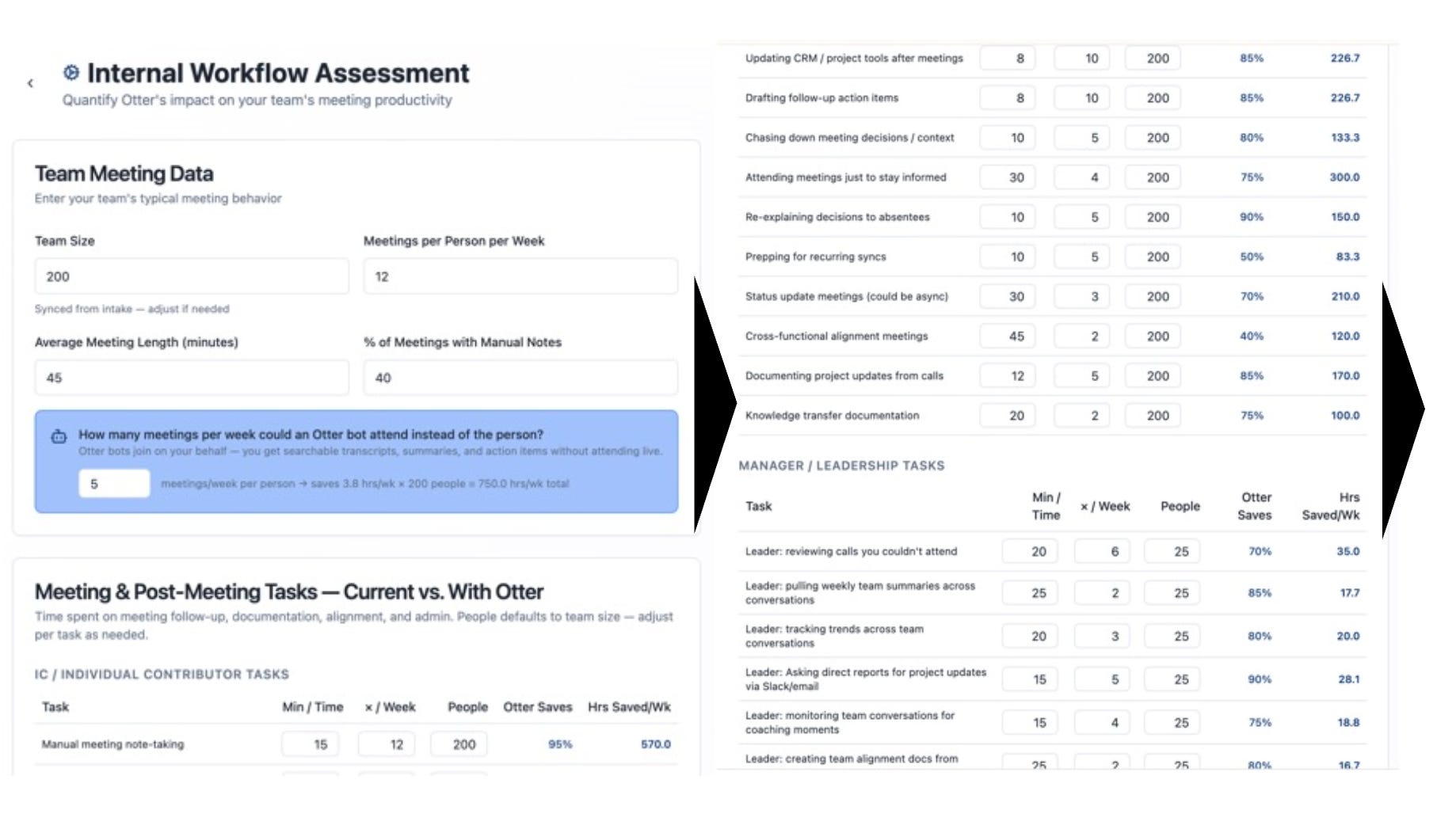
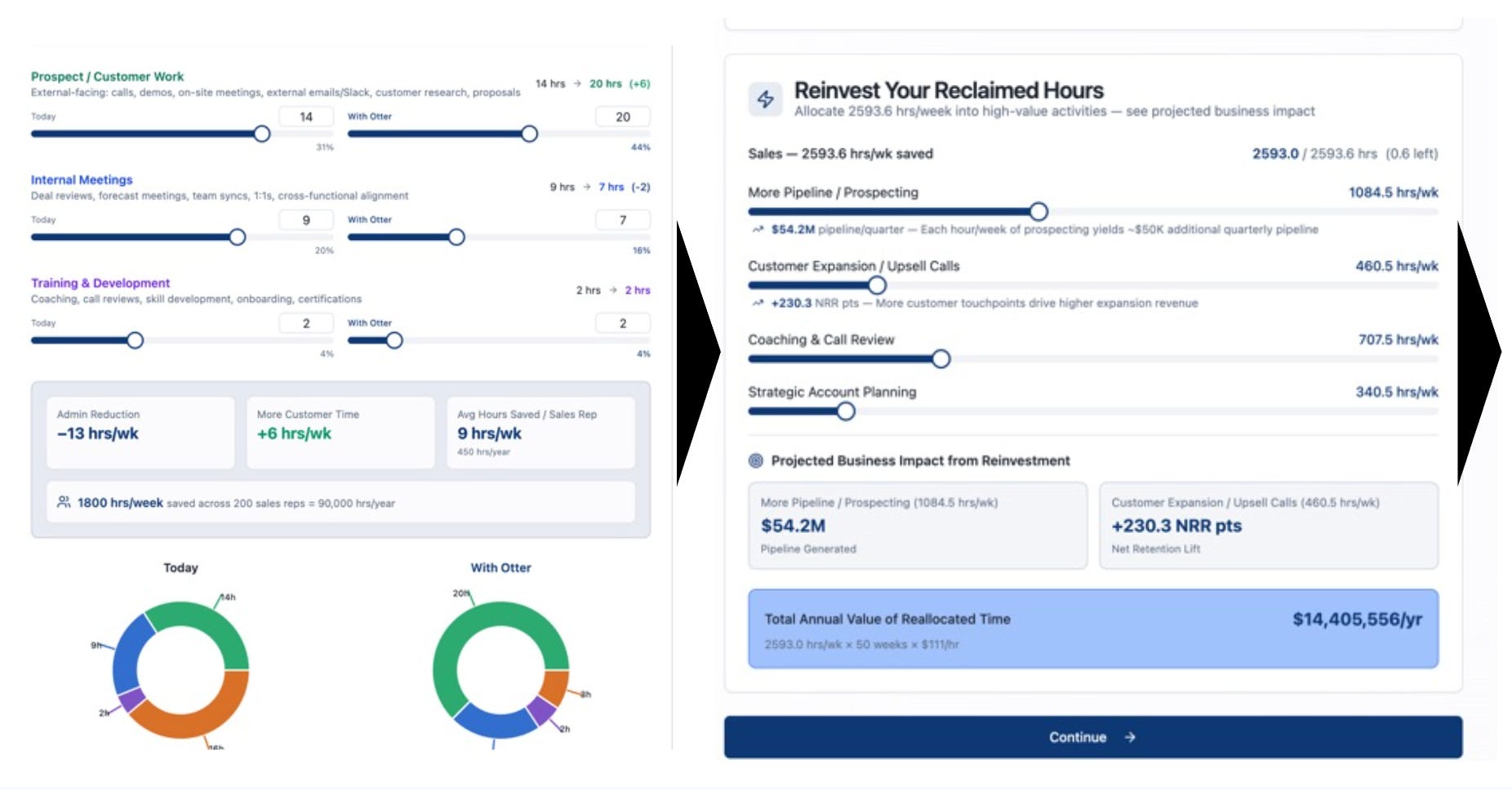
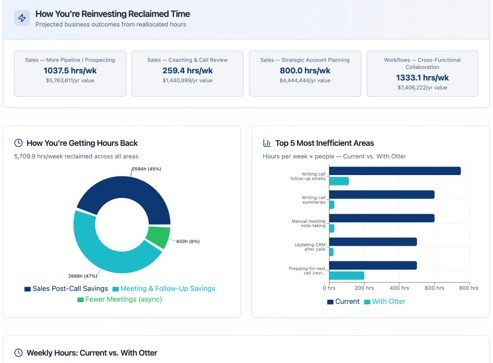
Works through a series of inputs with their prospect: The output of the workflow looks less like a static ROI calculator and more like an operational assessment. The prospect can see the inputs: team size, meetings per person, average meeting length, manual note-taking, follow-up work, manager review time, and hours that can be reallocated. The model then translates those inputs into reclaimed hours, reduced admin time, more customer-facing capacity, and projected business impact. That matters because the CFO can inspect the logic. The case is not “trust our 10x benchmark.” It is “here is how your own workflow changes, task by task.”:
A Word of Wisdom
AI can assemble the case, but it’s only working with the data you provide. This business case is ultimately only as good as your discovery. As Kenny says: “You have to run a great discovery to actually do that. So if we’re missing information, we have to double down. But it’s a good start.”
And on big deals, the AI output is a starting point, not a final answer. “For larger strategic opportunities, I’m still reviewing the business case personally. AI accelerates the process, but judgment still matters. I’ve seen ROI estimates come in both too conservative and too aggressive. The quality of the output depends on the questions we asked and how well we quantified the answers.”
The team still needs to ask the right questions in discovery. Reps still need to know their product’s time-savings well enough to fill in accurate inputs. And someone needs to sanity-check the output before it goes to the CFO on a big deal.
CFOs are looking for proof. Give them math they can verify using their own data and the conversation changes. Go log in to Lovable and try this out for yourself.
Until next week!
A useful reminder that credibility often comes from the quality of the inputs, not the sophistication of the model. Building a business case from a prospect’s own data and workflows creates a much stronger foundation for evaluation than relying on generic benchmarks or assumptions.